
When Budget Pressure Drives Tool-First Decisions
David Pinto | Principal Consultant | RenewalsHub
Why Tools Implementation Order Determines Renewals ROI.
Summary
When renewal performance starts to weaken, the fastest response by leadership often appears to be new technology. Under pressure to show momentum - and encouraged by vendors who frame underperforming renewals as a tooling problem - leaders often jump straight to new systems implementation. But tools can only scale the operating model that already exists. If the structure behind renewals is broken, technology will simply scale the dysfunction.
The Tool-First Pattern in Renewals
Renewals performance criteria rarely deteriorate all at once. More often, leaders begin to notice subtle signals that something is not working as well as it should, or as historical performance results have shown. Critical renewals performance-impacting factors - including forecast accuracy, late-stage escalations, discounting discipline and the recognition and execution of expansion opportunities - become less reliable as the quarter progresses.
Individually, these signals may not appear alarming or be an immediate cause for concern. But taken together, they indicate that the renewal motion is becoming less stable and results increasingly unpredictable.
When this happens, renewals leadership’s attention quickly follows. The question that often surfaces is straightforward: what action can improve renewal performance immediately?
In many renewals organizations, the most immediate answer appears to be technology, as automation platforms promise more consistent engagement, workflow tools promise efficiency, and dashboards promise better visibility into the renewal pipeline.
Under pressure to show progress, deploying systems can feel like the fastest and most tangible step forward.
Yet the results of these deployments are often mixed. Activity increases, reporting improves, and teams may appear more organized. But the core challenges - forecast volatility, reactive engagement, and inconsistent expansion capture - frequently continue.
In many cases, the issue is not the capability of the tools themselves. It is the sequence in which organizations choose to implement them.
In renewals operations, implementation order determines ROI.
Why Renewals Leaders Often Move to Tools First
The decision to deploy new technology is rarely irrational. In many cases, it is a logical response to the pressures renewals leaders face.
Reason 1 - Budget pressure pushes leaders toward visible action
Budget cycles often shape the actions available to renewals leaders when renewal performance comes under pressure. By the time renewal performance becomes a focus of executive attention, most operating budgets and headcount plans have already been finalized for the fiscal year. Structural changes - such as redefining ownership, adjusting coverage models, or redesigning cross-functional processes - can be difficult to implement mid-fiscal year. Technology investments, however, often remain available within existing budget categories, making them the most accessible option for demonstrating action.
Reason 2 - Pressure to show immediate progress
At the same time, leadership teams typically want to see visible progress quickly. Technology provides tangible signals of action - new dashboards, automated workflows, and system-generated engagement. Strategy and operating model design, while essential, can take longer to produce visible change.
Reason 3 - Technology vendors frame the problem as a tooling gap
Tool vendor narratives also play a role. Most renewal platforms present the problem as a tooling gap: better automation, stronger analytics, or more sophisticated reporting. The implication is that deploying the system will materially improve renewal outcomes.
Reason 4 - Renewals complexity makes tools feel like the organizing mechanism
Finally, the complexity of renewals itself can push organizations toward technology as the organizing mechanism. The renewals motion touches Sales, Customer Success, Renewals, Finance, Channel partners, and Operations. When coordination across these groups becomes difficult, systems can appear to offer a way to enforce structure and alignment.
Taken together, these forces make a tools-first approach understandable.
The instinct to move toward tools is understandable when leaders are under pressure to show activity. But when organizations take a tools-first approach - using technology to solve an operating model problem before the operating model has defined what the technology should enable - the consequences often only become visible within the first few quarters.
The Challenges Created by a Tool-First Approach
The consequences of a tool-first approach rarely appear immediately. In many cases, early indicators appear positive. Activity increases, engagement becomes more structured, and dashboards provide improved visibility into the renewal pipeline.
However, as the renewal motion matures, deeper structural challenges often begin to surface.
One key challenge is that technology tends to amplify whatever operating structure already exists. When ownership is unclear, processes vary between teams, and responsibilities overlap, systems simply execute those inconsistencies at scale. Workflows may become automated and reporting may improve, but the underlying renewal motion remains fragmented. Automation scales whatever structure already exists.
Another challenge emerges around organizational alignment. Because renewals sits at the intersection of multiple functions - Sales, Customer Success, Renewals, Finance, Channel partners and Operations - technology investments are often implemented within departmental boundaries (read silos!). Sales teams may implement quoting or forecasting tools, Customer Success may deploy lifecycle automation, Renewals may utilize longtail customer engagement automation, Finance may focus on contract management or billing systems. Each investment can make sense locally, but the overall renewal motion often remains disconnected.
A further challenge is that activity increases without necessarily improving structural performance. Outreach campaigns may expand. Additional dashboards and metrics appear. Workflow automation may generate more customer engagement. Yet the underlying issues frequently remain unchanged. Engagement timing can still be reactive, expansion opportunities are captured inconsistently, and forecast volatility continues. Renewal teams often find themselves working harder without achieving greater predictability.
Over time, these structural limitations make scaling the renewal motion more difficult. When systems are configured around an undefined operating model, extending the process across additional segments, geographies, or channel ecosystems becomes increasingly complex. What initially appeared to be a scalable solution begins to require growing levels of manual coordination.
The negative economic consequences of a tools-first approach often appear quickly - often within the first few quarters. Early gains may appear promising. Activity increases, reporting improves, and teams initially feel more organized.
Because the underlying operating model was never clearly defined, the technology ends up automating fragmented processes rather than enabling a coordinated renewal motion. The result is that the early increase in activity does not translate into sustained improvements in renewal performance.
Technology is now in place, but the renewal motion it was meant to support was never fully defined.
With a tools-first approach, performance often stalls within a short period without delivering meaningful long-term structural improvement.
Implementation Order Determines Renewals ROI
Deploying technology before defining the operating model may accelerate activity in the short term, but organizations that invest first in strategy and operating model design often achieve stronger and more durable renewal performance over time.
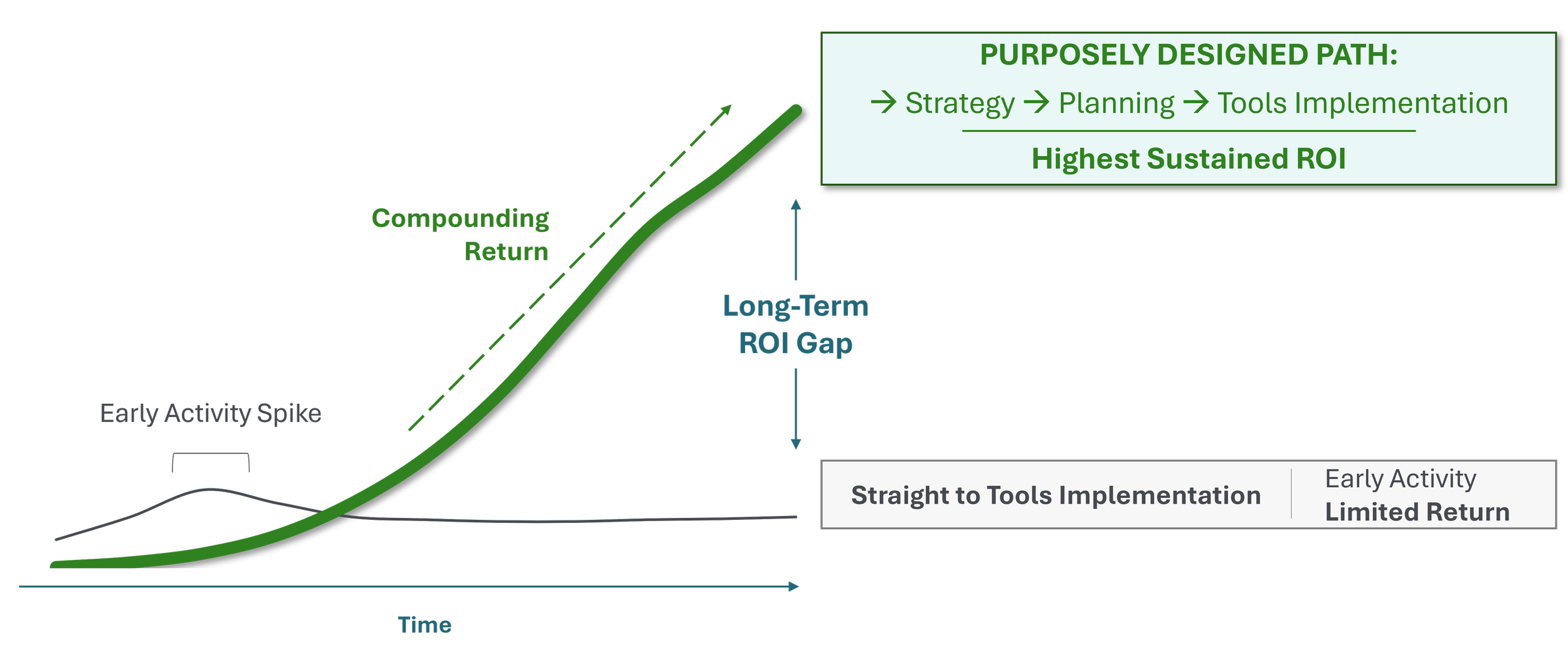
This visual illustrates how the two implementation approaches diverge over time. Organizations that move directly to tools often see an early increase in activity as automation, workflows and reporting become more visible. But without a clearly defined operating model, improvement quickly plateaus.
Organizations that first define the renewal strategy and operating model, and then deploy technology to scale that design, tend to see more consistent gains as the renewal motion becomes structured, aligned and repeatable.
Disciplines Renewal Leaders Should Promote
The goal is not to avoid technology. The goal is to deploy technology after the renewal operating model has been defined. Achieving this requires a small set of operating disciplines that guide how renewal organizations design, align and scale their motion.
The first discipline is to design the renewal operating model before selecting or deploying systems. This means clearly defining renewals ownership across Sales, Customer Success and Renewals, establishing coverage models by segment, determining the appropriate timing of renewal engagement, and defining how expansion opportunities should be identified and captured within the renewal motion.
A second discipline is aligning cross-functional roles before implementation begins. A company’s renewals motion is naturally cross-functional, touching Sales, Customer Success, Renewals, Finance, Channel partners and Operations. Alignment across these teams should be established before systems are used to implement the process. When systems are deployed before roles and responsibilities are clearly aligned, technology often reinforces the very fragmentation it was meant to resolve.
The third discipline is using technology to scale the renewal motion rather than define it. Systems should accelerate execution, improve visibility and automate repeatable activities. But they should not be responsible for defining the renewal strategy itself.
Technology should scale the renewal motion - not define it.
Closing Insight
Renewals is often treated as an operational afterthought, yet it functions as one of the most important revenue engines in a recurring revenue business.
And revenue engines depend on architecture.
Technology can accelerate the renewal motion, but it cannot design it. Organizations that move directly to tools often create visible activity without meaningful structural improvement. Organizations that invest first in strategy and operating model design before implementation tend to generate compounding performance gains over time.
In renewals operations, technology will scale whatever structure exists - whether that structure works or not. Make sure the renewal operating model is designed before the technology is deployed.
Where does your renewals operating model stand?
At RenewalsHub, we help organizations design renewals operating models that scale and evolve - across coverage models, playbooks, governance and automation. If your renewals transformation delivered early momentum but hasn’t sustained performance, our our free 2-minute RenewalsHub Renewals Maturity Self-Assessment can quickly highlight where operating model design may be limiting progress.