
RenewalsHub Renewals Execution Orchestration
Sustaining alignment as renewal execution scales and evolves.
Renewals Execution Orchestration is the control discipline of the RenewalsHub system. It exists to maintain alignment across renewals execution - ensuring ownership is clear, decisions happen on time, and change is absorbed without breaking the system.
The Four Elements of Renewals Execution Orchestration
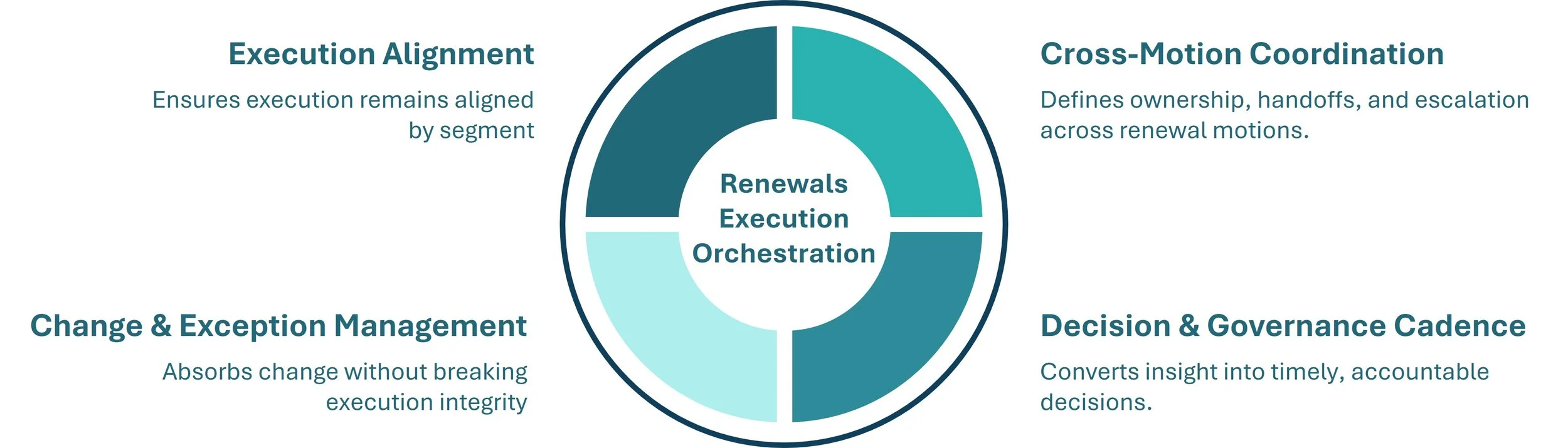
These four elements operate as a closed control loop - reinforcing one another to keep renewals execution aligned over time.
Renewals Execution Orchestration ensures that strategy and execution remain aligned as scale and conditions change.
Why Orchestration Exists
Why execution breaks without orchestration
Most renewal breakdowns don’t occur because strategy was wrong - they occur because execution loses alignment over time.
Ownership becomes unclear, handoffs weaken, exceptions multiply, and decisions slow down. Without an orchestration layer, even well-designed renewal systems fragment as scale and change increase.
The Four Elements of Renewals Execution Orchestration
Execution orchestration is not a single function. It is a system composed of four tightly connected elements that operate as a continuous control loop.
Execution Alignment
Definition
Execution Alignment ensures renewals are executed consistently by segment and route-to-market - without silent deviation or fragmentation.
Why it matters
When execution loses alignment, segmentation weakens and parallel motions emerge.
What it governs
Model adherence by segment and route-to-market
Approved vs. unapproved variation
Detection of parallel or shadow motions
Cross-Motion Coordination
Definition
Ensures renewal motions operate as one system—with clear ownership, clean handoffs, and defined escalation paths.
Why it matters
Most breakdowns happen between teams, not within them. Orchestration prevents gaps and overlaps before they impact customers or revenue.
What it governs
Ownership boundaries
Handoffs and dependencies
Designed escalation paths
Decision & Governance Cadence
Definition
Turns insight into timely decisions through clear decision rights, operating cadence, and escalation thresholds.
Why it matters
Without a cadence, insight becomes reporting. Orchestration makes decisions fast, visible, and accountable.
What it governs
Decision rights
Operating cadences
Escalation thresholds
Change & Exception Management
Definition
Manages exceptions and change without breaking execution integrity or creating parallel execution paths.
Why it matters
Without control, exceptions accumulate and execution becomes inconsistent.
What it governs
Exception classification
Temporary vs. structural change
Feedback loops into design
What Execution Orchestration Delivers at the Executive Level
Execution orchestration creates different value depending on the lens - but all outcomes stem from the same integrated control system.
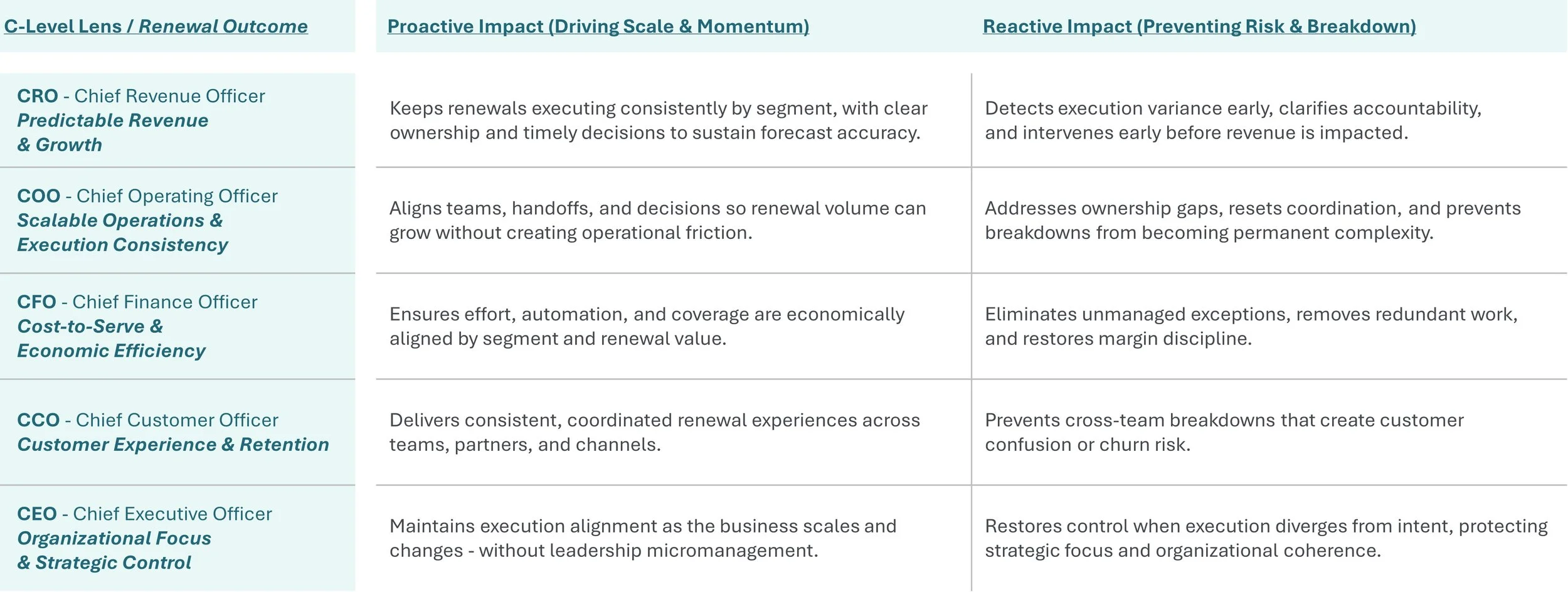
Execution Orchestration is not a role or a team - it’s how renewal execution stays aligned as scale and complexity increase.
Sustaining Performance Over Time
Right-Fit Renewals™ ensures renewals are executed correctly by segment.
Renewals Execution Orchestration ensures that execution remains aligned, governed, and adaptable as scale, complexity, and change increase.
Together, they protect long-term renewal performance without relying on heroics or constant intervention.
Right-Fit Renewals™ ensures execution is correct.
Renewals Execution Orchestration ensures it stays that way.
There is no required sequence - organizations engage each discipline based on the execution challenge at hand.